
Pennsauken Previous Residents by Era
A Pennsauken address history works best when each source is placed in its own time range and role. Recorded ownership, a listed phone subscriber, a census household, a directory occupant, and an estate contact are not interchangeable. Start with the source nearest to the period being tested, then compare the same address or legal description in a second source. The table separates the online record trail from library and historical-society material, including limits that must not be guessed past.
| Source | Years It Covers | Where Held | What It Shows |
|---|---|---|---|
| Camden deed index | 1978-present online | Camden County Clerk | Recorded owners, liens, instruments, and legal descriptions |
| Camden County directories | 1863/64-1947, with gaps | Camden County Library | Address and household clues; Pennsauken is listed for 1940-43 |
| Telephone directories | Library 1960-present; CCHS Camden 1921-1998 | Library storage and CCHS | Listed subscriber and address, not every household |
| Federal census | Library 1850-1930; CCHS 1830-1950 | Library, CCHS, Ancestry, HeritageQuest | Household at the census date, subject to the 72-year rule |
| CCHS maps and deeds | Maps 1856-1907; deeds 1600s-1900s | CCHS research library | Parcel context and historical ownership clues; Camden focus varies |
| Municipal files | No online year range identified | Pennsauken custodian | Inspection, transfer, construction, or occupancy dates after file confirmation |
For a newer Pennsauken trail, use the parcel and deed sources first. For an earlier Pennsauken household, start with the closest surviving directory or census year, then use maps, newspapers, or an obituary to test the connection. The online index is not a safe cutoff for the beginning of local land history.
Pennsauken Address Records Before Deeds
Before tracing previous residents through the deed index, capture the parcel keys. The Camden County TaxDataHub can connect a Pennsauken property address with an owner, mailing address, class, sales details, building information, and block-lot-qualifier fields. The mailing address is for notices and may differ from the Pennsauken situs address, which is where the parcel lies. Neither one proves that a named owner lived at the property.
The Camden County myiDV viewer adds Address Search, Street Search, Owner Search, Block/Lot Search, and PIN Search. Save the site address, owner name, block, lot, qualifier, and PIN before entering the recorder system. A block/lot or PIN is often more stable than a street number when a subdivision, route name, or old address form changes.
Note: Tax, GIS, and deed tools use different parcel keys, so compare their records instead of expecting one screen to answer every question.
Trace Pennsauken Previous Residents
The deed chain identifies prior recorded owners, not every past resident. Begin with the current Pennsauken parcel record and search the Camden County Online Property Records index by the legal description and current owner as grantee. The purchase deed names the prior grantor. Then search that seller as a grantee, using the same legal description, to find the earlier acquisition. Compare the legal description at every step because a familiar street number can span a revised lot, subdivision, correction deed, or adjacent parcel.
- Record the Pennsauken situs address, tax owner, mailing address, block, lot, qualifier, and PIN from the tax and GIS tools.
- Search the current owner as grantee and search the legal description in the land index.
- Open the purchase deed and note the prior grantor, recording date, instrument or file number, municipality, and linked documents.
- Search that grantor as grantee with the same legal description, then repeat the comparison backward.
- When the chain reaches the online boundary, ask the County Clerk to confirm the current book, microfilm, or office-request route before assuming no earlier record exists.
- Grantor
- The party transferring an interest in a recorded instrument, often the seller in a deed.
- Grantee
- The party receiving that interest. Searching a prior grantor as grantee can reveal an earlier purchase.
- Chain of title
- The sequence of recorded transfers tied to the same parcel or legal description.
- Legal description
- The lot, block, map, or metes-and-bounds description used to identify land more precisely than a street address.
Pennsauken Previous Residents After 1978
Camden County's online land-record index begins January 1, 1978 and is updated nightly. Basic Search is free and permits unlimited printing, but the documents are watermarked as unofficial. A Premium account costs $25 per month after registration, removes the watermark, and adds document classes such as liens, trade names, and powers of attorney. The Clerk's Standard and Advanced search tabs support party names, document type, date ranges, book and page, clerk file number, consideration, and town, lot, block, or map information.
Camden County Online Property Records describes the public access tiers and coverage for a Pennsauken deed-chain search.
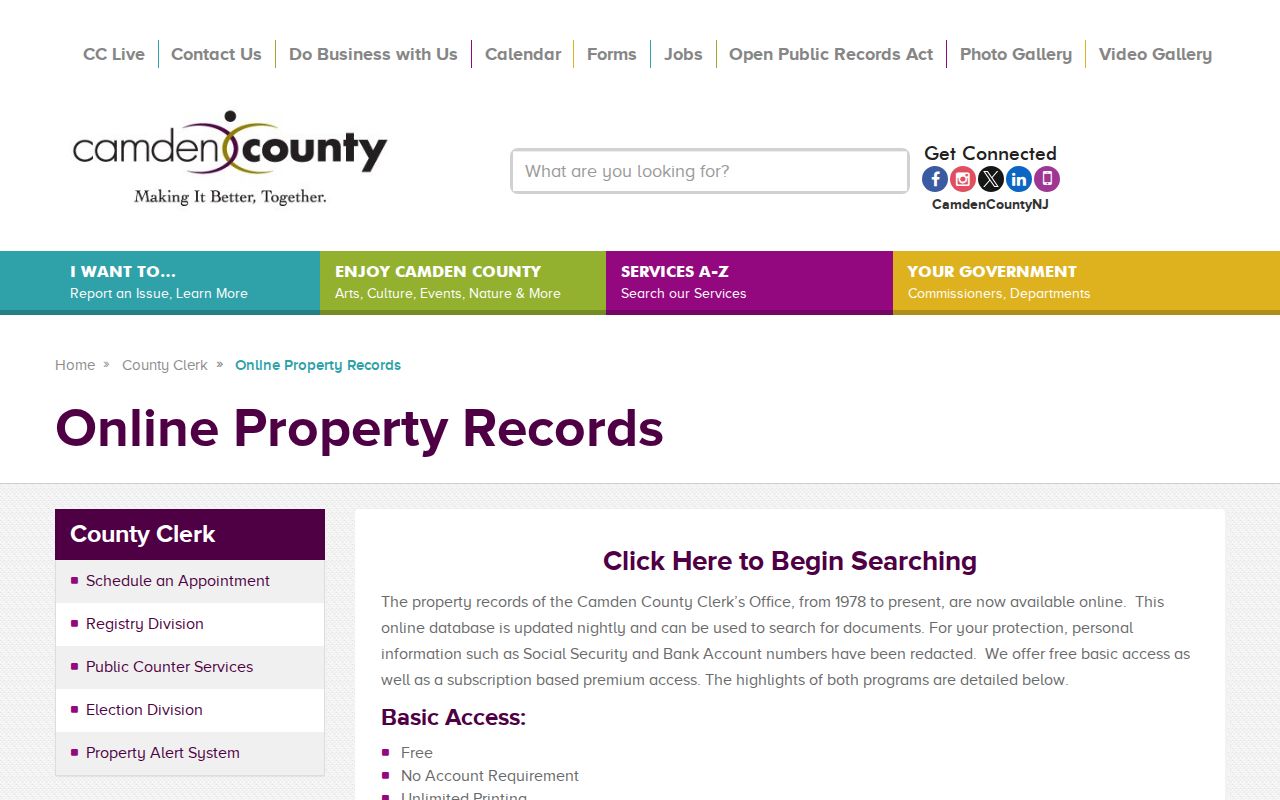
The recorded index can start a Pennsauken ownership timeline, while older book and microfilm access must be confirmed with the Clerk because no current pre-1978 process or cutoff was verified.
For a Pennsauken name that changes form, use the index's More Names option, automatic beginning wildcard behavior, ALL or ANY logic, and a second-party AND search where useful. The result grid lists one party per line. Document detail, image access, linked documents, and history can help explain a correction deed, release, estate, or other chain break. Spelling variants still need separate searches.
Pennsauken Past Resident Records
For people who lived at an address, pair directory years with census years instead of treating a deed as a household list. The Pennsauken City Directory collections hold the detailed shelf information, but the address workflow is simple: copy the directory entry, find the closest released census household, and then test a move or disappearance with a deed, newspaper item, telephone listing, or obituary. A directory listing can be an occupant or subscriber clue; a census names a household at one date.
- Choose the surviving Pennsauken directory volume nearest to the period under review and record every initial and address detail.
- Check the closest released federal census schedule, keeping its date separate from the directory publication date.
- Compare spouse references, age pattern, street spelling, and nearby family names without forcing a match from surname alone.
- Use a listed telephone number, news item, or deed date to place the household before or after a documented change.
- Mark each conclusion as recorded owner, directory occupant, listed subscriber, or census household rather than combining those roles.
The Camden County Library provides Courier-Post microfilm from October 1949 to the present, census microfilm for Camden County from 1850 through 1930, Ancestry Library Edition at all branches, and HeritageQuest at home with a library card. Those routes are useful when one Pennsauken address produces a partial trail.
Pennsauken Directory Records in 1940-43
The library's 1940-43 county directory reel grouping explicitly includes Pennsauken Township. Its 1943-47 grouping explicitly excludes Pennsauken, and the earlier grouping notes a missing 1941/42. This is a useful Pennsauken historical window because a 1940 directory entry can be tested against the 1940 census household. It is also a reason to avoid a false conclusion: an absent Pennsauken listing in the 1943-47 run may reflect the collection's township coverage rather than a move.
For older records, search newspaper microfilm with both Pennsauken Township and Stockton Township, plus a street, route, or nearby intersection. Pennsauken was incorporated from Stockton Township in 1892, so a predecessor name can bridge an address trail that a modern spelling misses.
Note: A directory omission is a coverage result until a second Pennsauken record supports a conclusion about the household.
Pennsauken Previous Residents and Probate
An obituary can close one part of a Pennsauken household trail when an accurate death date is known. Camden County Library says it has no obituary index, but staff may sometimes help with an out-of-town obituary request supplied with that exact date. CCHS adds obituary files, cemetery resources, and the WPA Death Index through 1937. Use a published obituary to identify a date and relatives, then verify estate facts with the custodian rather than publishing details beyond the public record.
The Camden County Surrogate records database searches by case type, first name, last name, and docket number. Estate records and related proceedings date from 1851, but file access may require an office request. The office offers appointment-only in-person service, mail, and a drop box, and asks researchers to call for the exact form or fee.
The Surrogate search page is the official starting point for a probate name or docket search connected to a Pennsauken address trail.
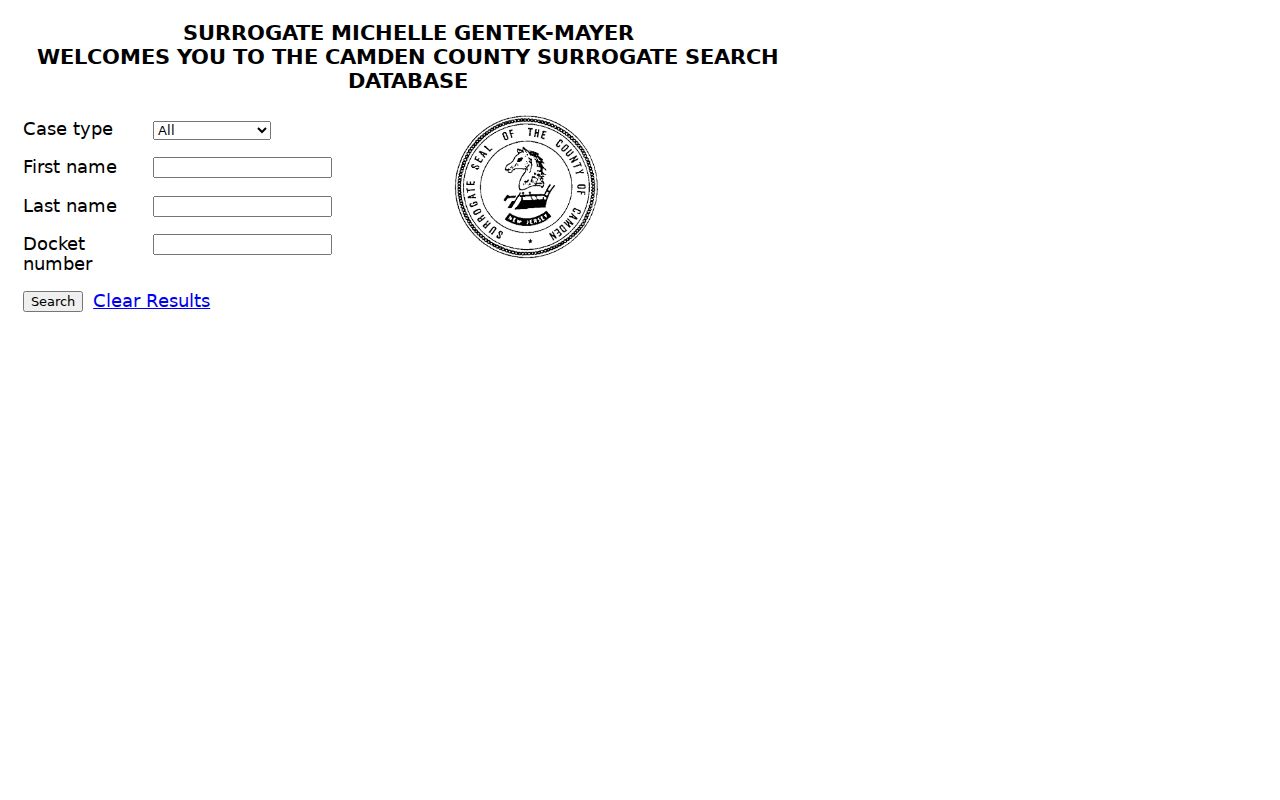
A probate record may connect a deceased owner to an executor or heir, but it is not proof that every named person lived at the Pennsauken address.
Pennsauken Address Records Before 1892
Pennsauken was incorporated from Stockton Township in 1892. Earlier records can therefore be indexed under Stockton Township, Camden County, a route name, or an older road description. No complete official Pennsauken street-renumbering or renaming list was located. Preserve the original record's jurisdiction name, then add the modern Pennsauken interpretation in brackets in personal notes. When the street number fails, use block and lot, a subdivision or plat name, owner surname, old and new address wording, or an adjacent intersection.
Maps, deeds, and building-contract descriptions at CCHS can provide useful context, but its Sanborn and map holdings are documented as Camden-focused rather than a complete Pennsauken set. A Pennsauken address trail remains stronger when the source page, instrument, volume, date, and the role of every named person are saved together.
Lawful personal research. Use Pennsauken address history for family, estate, or property curiosity, and never use a result to stalk, harass, or harm a living person.